What a recreational angler may do in Greece, in plain words.
General rules
No recreational fishing licence is required
No licence of any kind, personal or for the boat, is currently needed for recreational sea fishing or spearfishing. Both were abolished by Article 14(2) of Law 4256/2014. All the other restrictions (quantities, gear, seasons, sizes) continue to apply in full.
An angler register and catch reporting are on the way
Regulation (EU) 2023/2842 obliges member states to set up a register of recreational fishers and an electronic catch-reporting system. On 30 June 2026 the Ministry of Rural Development told Parliament that the Greek provision was still being drafted and that the IT system would go live once it is enacted. At the time of our check we found no such obligation in force, but this may change soon.
Each amateur may keep a total of up to 5 kg of fish or cephalopods (squid, cuttlefish, octopus) per 24 hours, with any permitted gear other than a longline. With a longline the limit is 10 kg. The exception is when a single fish weighs more by itself.
Of the groupers of the genus Epinephelus (dusky, white, goldblotch and their relatives) only one fish per angler per day may be kept, whatever the gear, spearfishing included. The minimum size is 45 cm. We found no separate, additional ban specific to spearfishing dusky grouper in the official sources we read.
It is forbidden to sell or otherwise trade fish and seafood taken by recreational fishing. Recreational fishing is fishing for leisure or sport, not for a living or for income.
Allowed without special restriction are the landing net, the hand spear and hooked gear: handline, trolling line, casting line, sabiki, pole, rod and line and the like. Also allowed are a longline with up to 150 hooks per angler and up to 300 in total per boat, up to two traps or pots per angler with mesh over 40 mm, and one cast net per angler with mesh over 30 mm and a diameter under 10 m. The cast net is banned within 500 m of river mouths and 200 m of fish-farm inlets.
Amateurs may not fish with nets: towed nets, encircling nets, purse seines, dredges, gillnets, trammel nets and combined bottom-set nets. Longlines for highly migratory species (tunas, swordfish) are banned as well. The old provision allowing 100 m of net no longer applies. The cast net is not covered by the ban; the lift net, however, is not allowed.
Recreational fishing with the aid of light sources is forbidden. The only exception is fishing with a hand spear, where one lamp with diffuse light, without a reflector, of up to 500 candlepower is allowed. Underwater lights are banned everywhere.
Every May spearfishing and recreational longlining are forbidden. The decree places no such restriction on rod, handline, trolling and the other hooked gears. Note that the Coast Guard FAQ page words it loosely, as a ban on "recreational or underwater fishing" in May; if you fish in May, ask your port authority.
No longline from the shore, no remote-controlled aids
Longlining from the shore is not allowed, nor is carrying out and dropping hooks with a remote-controlled or other aid (bait boat, drone). Electric hauling of handlines and trolling lines is allowed, until the legislation is revised.
Recreational fishing from any floating craft is forbidden in lagoons and in fish farms belonging to the State or local government, leased or not. Recreational harvesting of sponges and corals is also forbidden.
It is forbidden in May; from sunset to sunrise; to anyone under 16; within 200 m of where bathers usually swim, of harbour works, navigation marks, fishing boats, marked nets and anchored ships; and in boat traffic lanes and the entrances of harbours or anchorages. Any air-supply diving apparatus is banned, even merely carried on the boat, as are underwater lights, nets, guns powered by explosive or chemical charge, taking fish from other people's gear, and a loaded gun out of the water. You may not take fish under 150 g.
A spearfisher must always tow a yellow plastic float with a yellow flag bearing a diagonal red stripe and the letters Υ.Δ. (underwater activity), visible from at least 300 m. If a boat accompanies the diver, the flag is fixed in a conspicuous place on it. The diver must stay within 50 m of the float or boat.
Bluefin, albacore and swordfish – not for the amateur
According to the Coast Guard, bluefin tuna, albacore and swordfish may be fished only by professional vessels holding a special permit, and are not part of the amateur's 5 kg. If you hook a bluefin, you release it alive at once. If it dies in the attempt, you inform the port authority, which takes the fish and gives it to a charitable cause. The detailed ICCAT and EU rules on recreational tuna and swordfish fishing were not read separately.
The Coast Guard FAQ states that an amateur may take octopus weighing more than 750 g. Anything smaller goes back into the sea alive. Octopus also counts towards the 5 kg limit.
Up to 20 urchins a day per angler and up to 30 in total per boat. They may be gathered only with a hand-operated urchin fork or rake, or by free-diving. The Coast Guard inspection sheet gives the permitted period as January, February, March, July, August and December, from one hour after sunrise to one hour before sunset, outside harbours and anchorages and more than 150 m from aquaculture units. Minimum diameter 5 cm without the spines.
An amateur may gather only three kinds of live bait: sand worm (Ophelia bicornis), limpet and hermit crab. Up to 30 individuals per species per day, or 60 per species when a boat is used, and in daylight only: from one hour after sunrise to one hour before sunset. Sand worm: over 5 cm, from 1 June to 31 January. Limpet: over 3 cm, from 1 June to 31 March. Hermit crab: over 5 cm, from 1 September to 30 April.
The Coast Guard inspection sheet lists what an amateur may take (fish, cephalopods, one grouper, sea urchins and the three baits) and adds that "recreational fishing of any other kind of catch is not allowed". On that reading mussels, clams, lobsters, crayfish, crabs and shrimp are not among the permitted catch. Before gathering anything of the kind, ask the port authority.
Mud shrimp, pharaoh worm, bibi, razor clam – sizes and closed periods
These baits are gathered by professionals and have rules of their own (Presidential Decree 109/2002), which is why they vanish from the shops at certain times. Mud shrimp (Upogebia): minimum 5 cm, closed May to August. Pharaoh worm (Eunice aphroditois): minimum 60 cm or 150 g, closed February to May. Bibi or brown peanut worm (Sipunculus nudus): minimum 15 cm, closed June to September. Razor clam (Ensis siliqua, Solen marginatus): minimum 8 cm, closed July to September.
According to the Coast Guard, only Greek-flagged boats may carry out recreational fishing inside Greek territorial waters (Article 32 of Legislative Decree 420/1970 and Article 5 of Regulation (EU) 1380/2013).
Recreational fishing is carried out in line with the provisions that apply to commercial fishing as well, so minimum sizes bind the amateur too. A fish under the minimum size goes straight back into the sea; at an inspection it is confiscated.
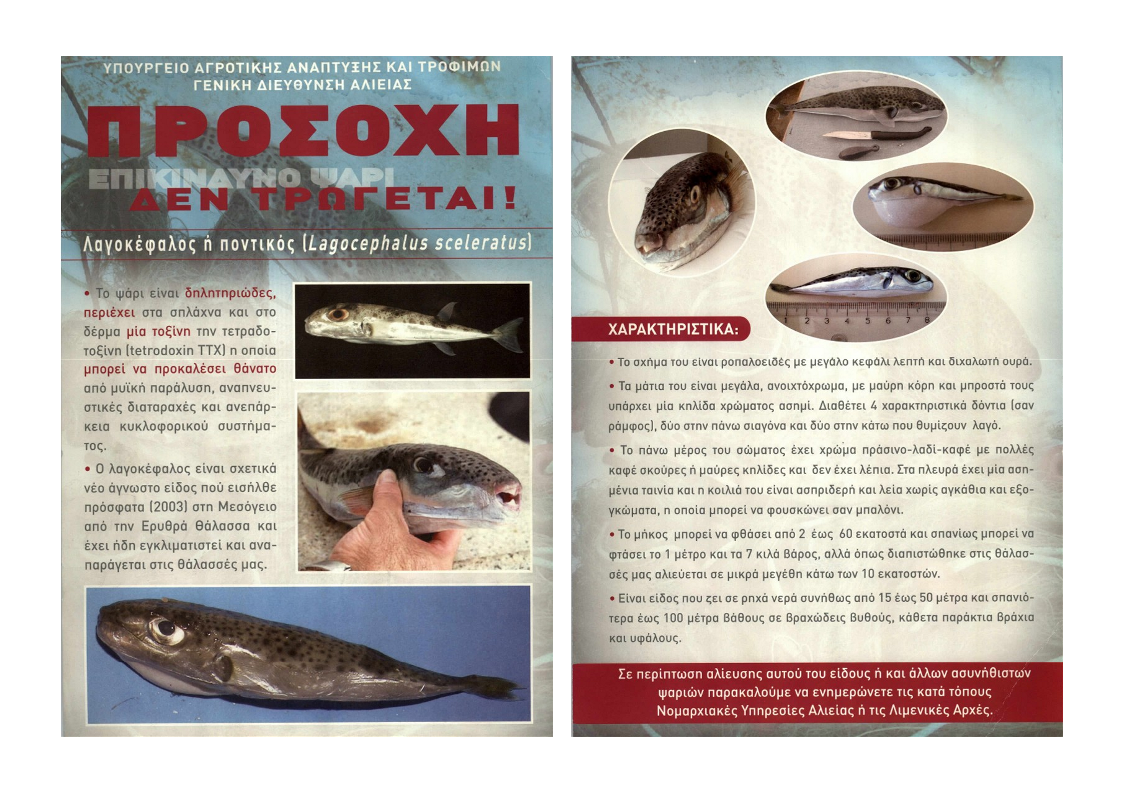
The silver-cheeked toadfish (Lagocephalus sceleratus) is poisonous: its guts and skin contain tetrodotoxin, which can kill. It must not be eaten however it is cooked, nor fed to animals. The Ministry asks you to inform the fisheries service or the port authority when you catch one. Selling it is forbidden in any case, like all recreational catch; the specific EU ban on marketing the poisonous fish of its family was not read during this check.
In marine parks and protected areas (for example Alonissos – Northern Sporades, Zakynthos), in harbours, near fish farms and at archaeological sites, additional local restrictions or outright bans apply. We have not listed them one by one; ask the local port authority before fishing somewhere unfamiliar.
SwordfishThe Coast Guard catalogue shows a minimum of 100 cm (or 11.4 kg whole, 10.2 kg gilled and gutted) and a closed period from 1 January to 31 March. This concerns professionals with a special permit; amateurs do not fish for it.Source 8
100cm
Bluefin tunaThe Coast Guard catalogue shows a minimum of 115 cm or 30 kg. This concerns professionals with a special permit; an amateur releases it at once.Source 8
115cm
Common octopusMinimum weight for amateurs 750 g, according to the Coast Guard FAQ.Source 1
Spiny lobster9 cm carapace length (90 mm) under the EU regulation; the Coast Guard catalogue also gives 420 g. It is not among the species an amateur is allowed to take.Source 6
9cm
European lobster30 cm total length or 10.5 cm carapace length. Not for amateurs.Source 6
30cm
Norway lobster7 cm total length or 2 cm carapace length. Not for amateurs.Source 6
7cm
ScallopPecten jacobaeus. Not for amateurs.Source 6
10cm
Venus shells and carpet clams25 mm (Venus spp., Venerupis spp.). Not for amateurs.Source 6
According to the Coast Guard catalogue (Presidential Decree 237/1996), fishing for and selling spiny lobster (Palinurus elephas) is forbidden from 1 September to 31 December each year. Lobster is in any case not among the species an amateur is allowed to take.
Catching, keeping, landing and selling it are forbidden throughout the country. Getting it out means breaking the rock, and the seabed is destroyed with it.
The Coast Guard FAQ lists eel, together with tunas and swordfish, among the fish that require a special fishing permit and are not part of the amateur's 5 kg. If you catch one, let it go.
Strictly protected species. If a turtle takes your hook, do not pull on the line: cut it as close to the mouth as you can and call the port authority or a rescue group. The exact legal provision was not read during this check.
Several Mediterranean sharks and rays are protected and may not be kept; the Coast Guard points to identification guides for them. The exact species list was not read during this check. If you are not sure what you have caught, let it go.